

AFROOJ AFTAB – One voice, more worlds
We are wired to perceive the unknown as a threat and avoid it. That’s why artists who create successful fusions feel almost miraculous — they make the unfamiliar familiar enough to open our ears.
I think the last thing you can do at an Arooj Aftab concert is try to classify her music. Not because it couldn’t be described — her dense yet crystalline voice, medieval Urdu poetry, jazz-rooted improvisation, minimalist electronics, South Asian tonalities — but because any list of influences seems to miss the essential thing: the way all of it together sounds like an invitation. Not into some exotic or unfamiliar space, but toward something you always sensed existed and never realized you wanted to hear. Everything she has achieved feels compressed in comparison to the scale of what she has built. That construction took two decades and began, as the best things often do, with the curiosity of a preteen in an apartment in Lahore.
Arooj Aftab was born in Saudi Arabia, where her Pakistani parents were living at the time, and remained there until the age of eleven, when the family moved to Lahore, her parents’ hometown. It was there that she received her first serious musical training — Pakistani classical music, the Urdu ghazal tradition, the sounds that would later form the backbone of everything she composed. But the turning point, the one she herself describes as decisive, came around the ages of ten to thirteen, through an impulse many people recognize: she had listened to the same song so many times that she wanted to keep hearing it without getting bored. The solution she found was to listen differently — not to the melody as a whole, but to its separate layers. The bass. The arrangement. The instrumental textures she had previously ignored. Songs opened up like books with hidden pages.
What followed this discovery was, in her own words, a kind of madness for a thirteen-year-old. She began imagining how she would rearrange the songs she listened to. She didn’t want to perform them differently — she wanted to completely restructure them. She had no instrument. No technical training in that direction. She didn’t know such a thing could become a vocation. But the impulse was there, clear and persistent, guided by a logic she describes simply: sometimes music feels like your destiny because there is no other explanation.
Her first contact with formal music education came through BerkleeMusic.com — the precursor to the online platform of Berklee College of Music — which she accessed while still in Pakistan. By the time she arrived in Boston in 2005, at the age of twenty, she already had direction. She studied music production and audio engineering, a deliberately technical choice rather than a purely artistic one. From Berklee she took away two essential things. The first was contact with musicians from dozens of different cultures, which transformed what had felt like a solitary journey into a network of references and conversations. The second was technical knowledge: a deep understanding of recording, mixing, and production — everything that allowed her to translate into sound what she heard in her mind. It was also at Berklee that she absorbed jazz, which would become one of the central pillars of her music. Not jazz as a style to imitate, but jazz as a working philosophy: collaboration, improvisation, deliberately leaving space open. That openness is not carelessness — it is architecture.
After Berklee, Aftab moved to New York, to Brooklyn, where she still lives today. Over the next decade she worked on the local scene, recorded, collaborated, and searched for a sound that would truly belong to her in the fullest sense of the word. Two albums emerged during this period. Bird Under Water from 2015 was an acoustic project — voice and delicate textures, understated and focused. Siren Islands from 2018 moved in the opposite direction: ambient electronics, layers of synthesis, a darker and more spacious aesthetic. The two albums coexist without contradicting each other, and that says something important about the way Aftab works: she is not searching for a fixed identity, but for a space broad enough to hold multiple identities at once. During this period, something specific to her sound also began to crystallize: the voice treated not as a leading solo instrument, but as one element within an ensemble where every participant has equal presence. Acoustic guitar, harp, electric guitar, strings, electronics — all are interconnected rather than serving merely as background.
Arooj Aftab released her third album, Vulture Prince, and the musical world began responding differently. It was not mainstream success in the conventional sense, nor was it aimed at a predefined audience, but it possessed something more valuable: the feeling of a work that could not have existed in any other form, that arrived exactly as it needed to, at precisely the right moment. The album is dedicated to her younger brother, Maher, who died unexpectedly during its production. His death altered the trajectory of the album in ways she neither planned nor could avoid. Grief entered the music not as an explicit theme, but as texture — in the string arrangements, in the timbre of her voice, in the pace at which the songs unfold and reconstruct themselves.
The songs are performed primarily in Urdu, with occasional passages in English. In Urdu she developed a vocal agility and a distinctive sound she does not possess in English. The intonation, inflection, and diction all change between the two languages, and she feels freer, more at home, in Urdu. Even the vocal risks she takes there are different. The lyrics are not entirely original. Rumi appears in “Last Night,” the only song sung predominantly in English, through a discreetly inserted verse. It is not an abandonment of her own voice, but a mature understanding of what it means to be a composer: sometimes the best thing you can do is find the right context for someone else’s words.
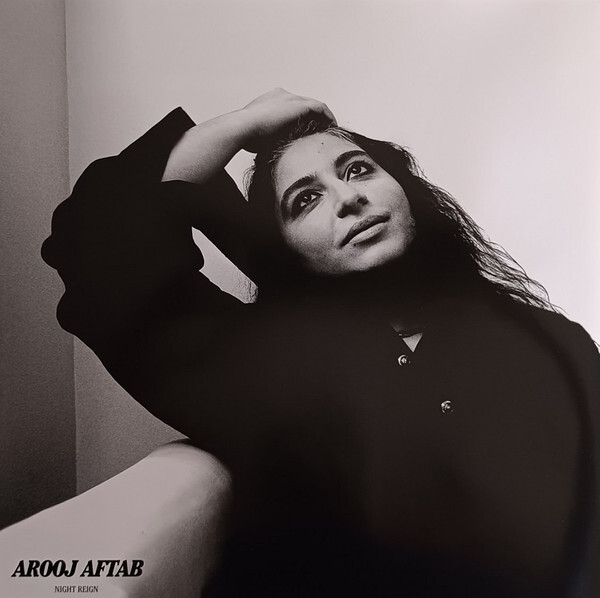
In 2024, Night Reign was released through Verve Records. If Vulture Prince was illuminated — even in its grief — by a breathing melancholy, Night Reign takes us somewhere deeper and darker: nocturnal not as an aesthetic, but as a state of mind. The album feels like crossing the night with her voice as the only guide. It begins by drawing you in as though through a curtain, then moves through a series of muted emotional states shaped by an expression that is intense, profound, yet strangely comforting. Jazz standards, meditations on love, monologues inspired by Mah Laqa Bai Chanda — an eighteenth-century noblewoman from Hyderabad — and a closing piece built on verses by Shamim Jaipuri. These names may not be familiar to us, but what Arooj Aftab communicates through them is extraordinary.
Her music is not the work of a soloist accompanied by other musicians. It is the music of an ensemble in which every contributor brings their own logic and their own sound, and from their intersection emerges something that could not otherwise exist. This is her central conviction, inherited from jazz: improvisation is not an addition to structure — it is the structure.
Love in Exile, the 2023 album recorded with pianist Vijay Iyer and multi-instrumentalist Shahzad Ismaily, takes this aesthetic even further. There are no compositions written out on paper — everything was improvised and recorded live. The result is meditative and oblique, at times difficult to follow as narrative, yet coherent as an experience. It is an album that demands a particular kind of attention and rewards it differently with every listen.
Aftab uses a precise term to describe what she does: world-building. She builds worlds. Her music is an encounter that produces something new with broad emotional reach, something that moves across generations and genres.
As a global musician, she has constantly navigated between multiple identities without ever being fully contained by any of them. Her music reflects that movement. You can remain in motion, continue changing and accumulating influences, without losing your sense of self. That is why her music never sounds like an artificially assembled fusion, like a multicultural experiment designed to tick boxes. It sounds like someone hearing several worlds simultaneously and translating them into a single language.
In a musical landscape where originality has become easier than ever to simulate — through production, marketing, and positioning — Arooj Aftab represents something rarer: an identity that comes from within, from two decades of deep listening, technical study, authentic collaboration, and the courage to let the music go wherever it wants to go. Her music works because it possesses authenticity in the purest sense of the word: it comes from a real source, from a childhood in Lahore spent obsessively replaying the same song until she could hear the bass separately from the melody. It comes from the death of her younger brother — a sonic gateway into an emotion too large to be named directly. It comes from the wisdom of knowing that the poetry of Rumi or Mah Laqa Bai Chanda can sometimes express something better than you ever could, and that your task is simply to find the right sonic context for it. And it comes from something even simpler: a voice that wraps itself around you like a spiral, slow and inevitable, fully aware of where it wants to arrive and willing to take all the time in the world to get there.
Written by Berti Barbera
Berti Barbera is a longtime friend of our festival, frequently appearing on stage with various musical projects, but above all as a devoted jazz listener. In 2025, he released Ascultă și dă mai departe, a book about the pleasure of listening to music, featuring the stories behind albums that left a significant mark on pop culture. The volume was also launched during the 2025 edition of Jazz in the Park. You can find the book here: Ascultă și dă mai departe