

RABIH ABOU-KHALIL – ”A unique map of the music”
There is a kind of music you cannot place geographically, and I don’t see why you should even try. Isn’t it better to surrender completely to the fabric of it as it carries you somewhere you never imagined? It doesn’t sound like the Middle East, it doesn’t sound like American jazz, it doesn’t sound like European chamber music, and yet it contains traces of all three, along with things you have never heard brought together before. When you listen to the music of Rabih Abou-Khalil for the first time, the initial reaction is a pleasurable disorientation: where does this come from? The second reaction, which follows quickly after, is that it doesn’t matter. What matters is that it exists. You are slightly lost, but not stranded.
Abou-Khalil was born in 1957 in Beirut, a city that during the 1960s and 1970s was one of the most cosmopolitan places in the world. That is not a worn-out metaphor: Beirut at that time truly was a cultural crossroads where Arab, French, American, Greek, and Armenian influences coexisted, each with its own music, literature, and architecture. He grew up listening to classical Arabic music at home, rock and jazz on the radio, while simultaneously studying the oud — the traditional Arabic string instrument he first picked up at the age of four — and the Western flute. Not as a deliberate intercultural experiment, but simply because this was the air Beirut breathed.
For the Arab world, the oud is what the piano or guitar is in the West — the composer’s instrument par excellence. It resembles a short-necked lute, has five or six pairs of nylon or gut strings, and produces a warm, rounded sound whose range encompasses both melody and harmony. A predecessor of the European lute and, through it, the modern guitar, the oud carries within it several thousand years of Arab and Persian musical culture. It is impossible to touch it without bringing all that sonic memory with you.
Abou-Khalil studied the oud with Wadih El Safi, one of the most important Arab musicians of the twentieth century. A composition course with him left a lasting impression. The young Rabih played him his first compositions, and Al-Safi helped him give them greater meaning. His father was a poet, which is why he always maintained a close relationship with literature. In composition, there must be a certain rhyme, a balance between musical elements, even if the language itself is symbolic.
The Lebanese Civil War forced him to leave the country in 1978. He settled in Munich, where he studied classical flute at the Academy of Music under the guidance of Walther Theurer. He made his recording debut in 1981 with Compositions & Improvisations — an album on which he plays flute — but almost immediately abandoned the instrument and returned to the oud, which he would use on all subsequent recordings. Exile did not distance him from his Arab roots; on the contrary, it gave him the analytical distance necessary to understand them more deeply. His engagement with the European classical tradition opened his eyes to the possibility of operating simultaneously within seemingly divergent musical systems. He did not seek fusion as an end goal, but coexistence as a method.
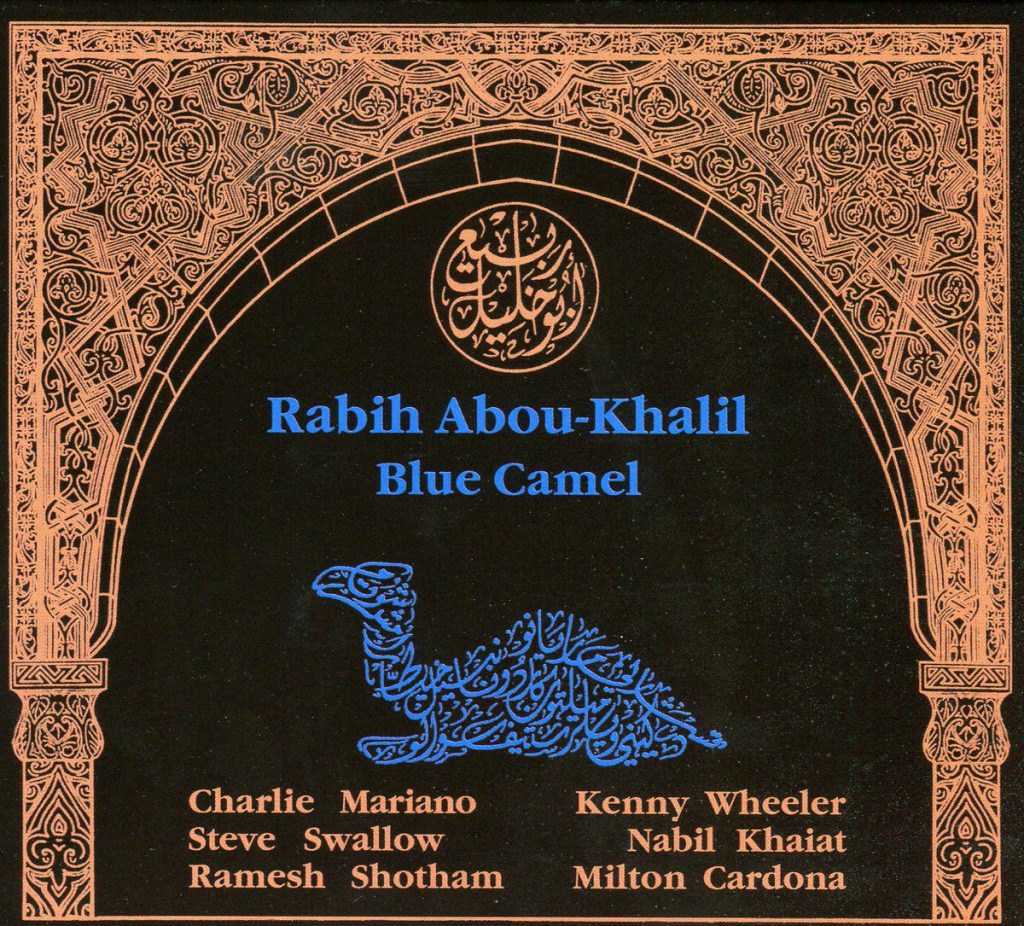
His first album for ECM Records was Nafas in the early 1980s, marking Abou-Khalil’s arrival on the international scene. If you follow his discography chronologically, you can clearly see how he gradually and consistently built a musical language unlike anything else in existence. His first seven albums for Enja, MMP, and ECM experimented with the fusion of classical Arabic musical ideas and jazz. With Al-Jadida and Blue Camel, recorded in the early 1990s, he began introducing Turkish musical elements into the equation. Arabian Waltz, recorded with the Balanescu Quartet, added the dimension of European chamber music.
Each new album introduced an additional ingredient, a new window into unexplored territory. But not in the sense of a collector of exoticisms — rather as the result of creative encounters. From the combination of diverse cultural elements emerges something deeply personal and coherent. Not East versus West, not “world music” in the sense of a tourist showcase, not orientalism, but a distinct language that has absorbed all of these things and transformed them into something entirely its own.
His instrumental virtuosity is exceptional, often recommended as study material for jazz guitarists — remarkable when you consider that the oud has no frets like a guitar, that intonation depends entirely on the player’s fingers, and that the scale system used in Arabic music includes microtonal intervals absent from Western tempered music. His ballads, on the other hand, revive memories of the poetic dawn of Arab culture without ever sounding traditionalist or predictable.
One essential detail about the way Rabih Abou-Khalil works: he never records solo. Frequently citing Miles Davis as a major influence in his pursuit of a coherent ensemble sound, he has spent years building groups in which the distinction between soloist and accompanist disappears. Everyone improvises, everyone listens, everyone contributes to the collective texture. Among the musicians he has collaborated with are Sonny Fortune, Kenny Wheeler, Glenn Velez, and Steve Swallow — major figures in international jazz who found in Abou-Khalil’s musical context a degree of freedom few composers offer. Yet the most stable core of his music over the last two decades has been formed by musicians who grew alongside the project itself: accordionist Luciano Biondini, tubist Michel Godard, percussionist Jarrod Cagwin, and Sardinian saxophonist and vocalist Gavino Murgia.
Murgia is a particularly singular presence. His vocal style recalls Tibetan kargyraa throat singing, a technique in which a single vocalist produces multiple frequencies simultaneously, creating the effect of internal polyphony. The fact that a Sardinian musician singing in the style of traditional Sardinian music sounds perfectly natural alongside a Lebanese oud player, an Italian accordionist, and a French tubist is one of the clearest proofs that the logic of Abou-Khalil’s music operates beyond any geographical logic. Here, maps are replaced by a shared musical current.
An album like Hungry People — a title referring simultaneously to hunger for food, hunger for knowledge, and hunger for music — contains pieces called “Bankers’ Banquet,” “Fish and Chips and Mushy Peas,” and “Shrilling Chicken.” This is not superficial music. It is a deliberate poetics of absurdity. “Bankers’ Banquet,” through the playing of Godard and Murgia, evokes the grotesque dance of those who take everything from the poor. “Fish and Chips and Mushy Peas” was born from a concert in London where English food literally stuck to his fingers. “Shrilling Chicken” is not dedicated to fast food, but to a plastic toy chicken gifted to him by his sister, whose clucking introduces an infectious Latin rhythm. By now, that yellow rubber chicken has probably become famous in its own right.
Music can be serious and undoubtedly must be approached seriously to remain credible. But musicians themselves should not take themselves too seriously. When they do, music loses its charm, much like a person who is perpetually serious eventually becomes unbearably dull. Through irony, we often understand the world more clearly. In the Middle East especially, everything frequently seems profoundly surreal and contradictory. That is why his compositions often carry surprising titles — to leave the listener more room for imagination. There is no need for overly profound titles with familiar gravitas.
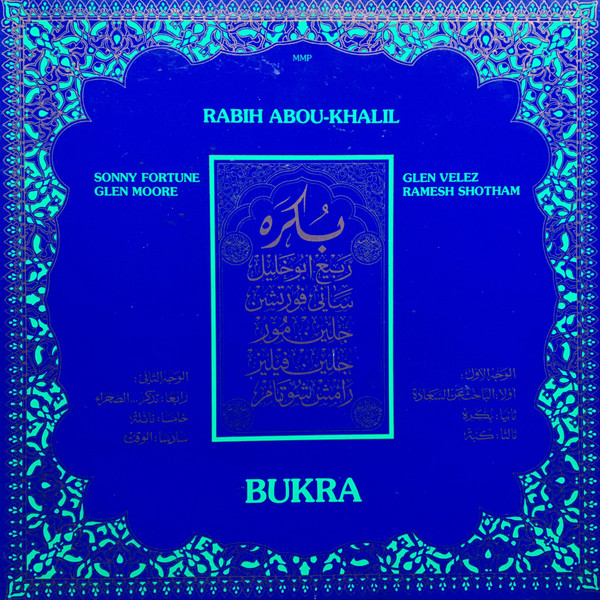
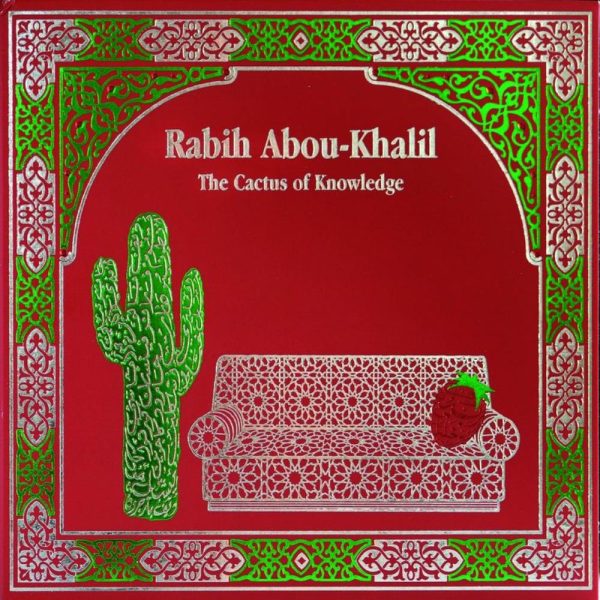
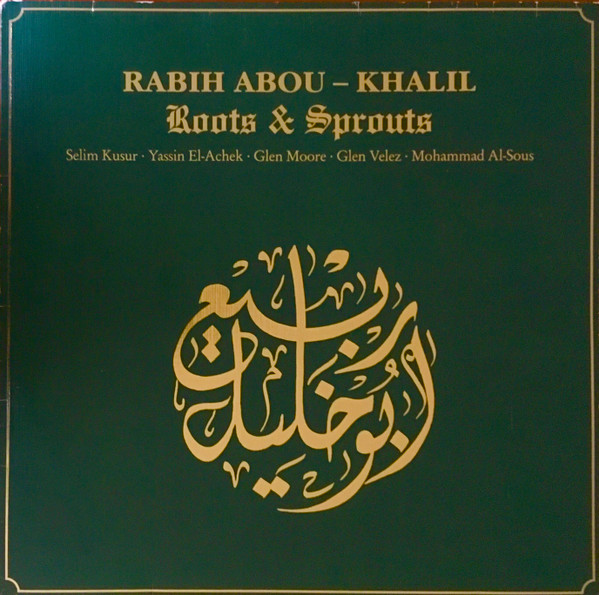
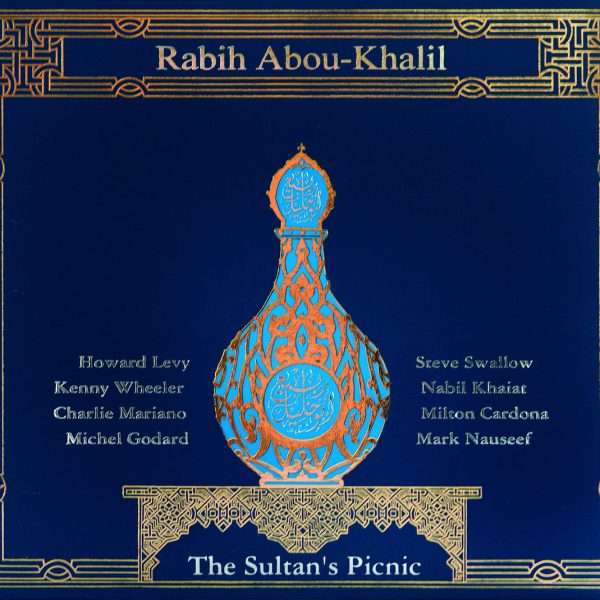
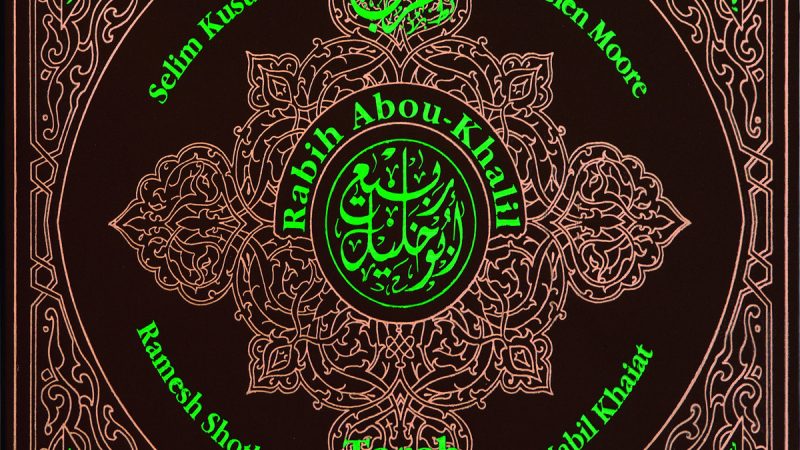
A less visible aspect of Abou-Khalil’s career, but one essential to understanding it, is the total control he assumed over his own music. He decided early on to produce and release his work independently, refusing the artistic compromises that subordination to a major label would have required. Every aspect of his work bears his personal signature — album cover design, recording quality, liner notes written with literary sensibility. His album covers are created in the style of traditional Arabic calligraphy and non-figurative art, a choice that is not decorative but conceptual. His music refuses geographical or stylistic categorization; the covers refuse illustration. The coherence is unmistakable.
This independence allowed him to undertake projects on a scale that an artist tied to a commercial label could scarcely have imagined. He composed for the Kronos Quartet, wrote for the BBC Concert Orchestra, collaborated with Ensemble Modern, composed for orchestras in Germany, Austria, and Macedonia, and worked with Silkroad Ensemble founded by Yo-Yo Ma. He also composed film music, including for Yara, an award-winning Turkish-German film directed by Yilmaz Arslan.
Rabih Abou-Khalil has received less attention from the mainstream music press than he deserves. Partly this is a consequence of his independence — he never had a marketing machine behind him — and partly because his music cannot easily be summarized in three words or three minutes. It is not jazz. It is not world music. It is not classical Arabic music. It is not chamber music. It is all of these things and something beyond them, mapped according to the coordinates of a deeply complex personality.
But for those who have discovered him, his music operates with rare force. It works because it does not try to be anything other than what it is — the expression of a man who grew up at the intersection of several worlds and chose not to choose between them, but to find a common language for all of them. It works because humor and seriousness coexist within it without canceling each other out. It works because a plastic chicken can coexist with the dreams of a dying city on the same album and both sound entirely believable. And it works because Abou-Khalil’s oud, in his hands, does not sound like an exotic instrument presented to a curious Western audience. It sounds like the only possible instrument for the music he makes.
Written by Berti Barbera
Berti Barbera is a longtime friend of our festival, frequently appearing on stage with various musical projects, but above all as a devoted jazz listener. In 2025, he released Ascultă și dă mai departe, a book about the pleasure of listening to music, featuring the stories behind albums that left a significant mark on pop culture. The volume was also launched during the 2025 edition of Jazz in the Park. You can find the book here: Ascultă și dă mai departe